Methodology
This page explains how BrailleLabBase maps Grade 1 cells. It is for people who want the rules behind the translator, not a marketing summary.
Grade 1 mapping
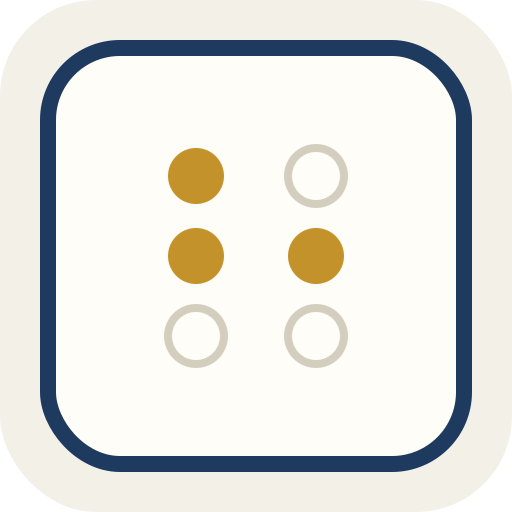
We follow English Grade 1 literary braille for common learning use: one cell per letter, a capital marker when needed, and digits via the number sign (dots 3-4-5-6) plus letters a-j for 1-0. Common punctuation uses the same Grade 1 tables. Unknown characters may pass through or be listed as skipped in the status line.
Capitals and number mode are simple learning conventions. They are not a full UEB production house. If your school or publisher uses a stricter house style, treat this output as a draft check, not certified transcription.
Unicode, dots, and ASCII views
Default output is Unicode Braille Patterns (U+2800-U+28FF). That is what most people paste into slides and documents. The dots view shows which of dots 1-6 are on in each cell. The ASCII view shows a legacy computer mapping. Use ASCII only if another tool asks for it. Do not confuse it with decorative ASCII art.
Where the work runs
Encode and decode run in a Web Worker when the browser supports it. That keeps a long paste from locking the page. The main thread still draws the UI. Nothing is uploaded for conversion.
What we refuse
- Full Grade 2 contracted engine
- Photo or camera OCR
- Hardware embosser drivers
- Full Nemeth math translation
- Vision-care advice or certificates
Where to read more
For full rulebooks, use BANA, Perkins, and UEB training materials. We point people there. We do not republish those manuals on this site.
Related tools: translator, alphabet, numbers. Questions: contact.